
From 30th October 2026, the Employment Rights Act (ERA) raises the responsibility on UK employers to prevent sexual harassment from ‘reasonable steps’ to ‘all reasonable steps’.
That shift has implications across policies, reporting routes, training, investigations and governance.
Two things are worth understanding from the outset.
First, the standard is evidential – a tribunal will not ask whether you meant well, but whether you can demonstrate what you did and why it was sufficient.
Second, the duty is anticipatory. Rather than waiting for a complaint, it expects organisations to have identified their risks and acted on them before anything goes wrong.
Statutory guidance on what all reasonable steps will require in practice is not expected until 2027 – after the duty is already live. But the EHRC’s existing technical guidance and the pattern emerging from previous tribunal decisions already give a clear enough picture to act on.
This article draws on both of these, alongside discussions from our Employment Rights Act webinar series, to look at what training needs to look like – and what good actually means in practice.
[Link]
The standard has changed
Since October 2024, UK employers have been under a positive legal duty to take ‘reasonable steps’ to prevent sexual harassment at work.
Under the new standard, an employer facing a tribunal claim needs to show more than that some steps were taken. It has to show that it took all reasonable steps and that there was nothing further it could reasonably have done.
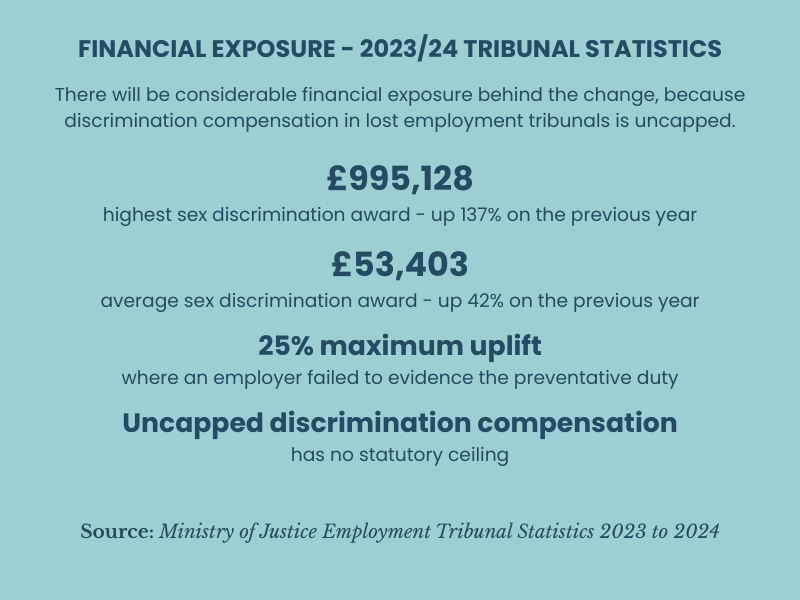
The Equality and Human Rights Commission (EHRC) can also enforce the duty, without waiting for a claim to reach tribunal. Its Technical Guidance is clear that training has to be current, differentiated by audience, and evidenced. This last point is the one most organisations haven’t yet fully addressed, and it’s where the first, and most familiar, failure shows up.
Think we should put the EHRC’s full name at the first mention rather than here
I’d move the reference to the EHRC enforcing the duty directly to the call-out box. The reference to being current, differentiated etc can then sit in the above para if needed?
I don’t think many have differentiated training either so not sure if we can confidently say this is true?
Training that can’t be proven, or has gone stale
One of the more common gaps we see isn’t that training never happened – it’s that organisations cannot evidence that it did, or that what was delivered had become outdated since it was last refreshed.
Tribunals will look beyond completion records. They will ask who attended, when, what was covered, and whether the content reflected the legal standard in force at the time. Increasingly, they will also ask whether it actually changed anything.
Two cases illustrate this well.
In one 2023 decision, store managers were found to be unaware their employer had an anti-harassment policy at all — let alone what it said. In another, an Employment Appeal Tribunal found that equality and diversity training delivered around 20 months earlier had become so stale it had, in the words of the judgement, lost its effect.
In both cases, the training that existed counted for nothing as a defence.
One practical step that addresses these issues: measure confidence before and after training, not just completion. Ask participants how confident they feel recognising unacceptable behaviour, stepping in, and reporting a concern – then ask again once training’s done. That before-and-after data is evidence of impact, not just delivery.
Line managers – your first line of defence
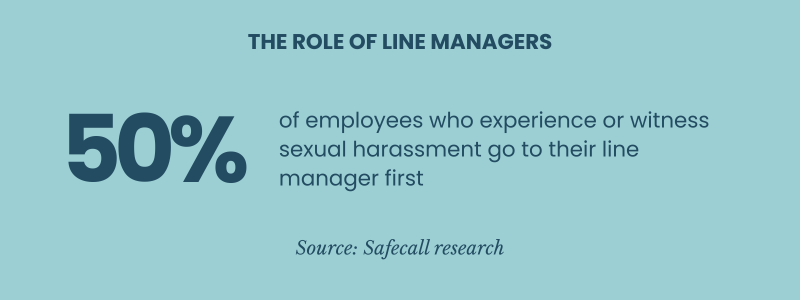
Our own research shows that half of employees who experience or witness sexual harassment go to their line manager first – before HR is involved, and before anything is formally recorded.
That makes manager training one of the highest-impact investments an organisation can make ahead of October.
Yet, it is consistently one of the most underdeveloped areas we come across.
The EHRC’s guidance is explicit on what managers need – not just awareness of what constitutes harassment, but training on how to receive and respond to a concern. What to say and what not to say, and how to escalate correctly and document what happened. General all-staff eLearning does not build those skills.
What we see in tribunal decisions reinforces this. In cases where manager training has been absent or inadequate, the consequences have been significant — both for the individuals involved and for the organisations that failed to prepare the people employees turned to first.
As one contributor put it in our webinar series, “you want your manager to call the fire brigade, not throw an old blanket on the flames”.
A manager’s role is not to fix it. It is to respond with empathy, take the concern seriously, and get it to the right place.
Why investigating sexual harassment requires a different approach
How an investigation is run matters almost as much as whether one happens at all – and it’s often where good intentions run into a lack of the right training.
What tribunal decisions in this area consistently point to is a skills gap more than a willingness gap. Intent, tribunals have made clear, is irrelevant – what matters is the effect on the person who experienced the behaviour. And how an investigation is conducted is itself evidence of how seriously an organisation takes that principle.
Trauma affects how people recall and describe what happened to them. Accounts can be non-linear, details can shift, someone may seem to contradict themselves under questioning. As Shaun McKillop, a former senior Police Scotland officer and one of Safecall’s workplace investigators, explained in our investigating sexual harassment webinar – you need to give people time, space and support to process what has happened. An account that does not follow a neat chronology may still be entirely credible. Without trauma-informed training, an investigator is likely to read those signs as unreliability, when in many cases they are normal responses to a distressing experience.
Getting this right isn’t about being less rigorous. It’s about being rigorous in the right way.
And alongside the trauma-informed decision, the basics still matter – clear terms of reference, a structured approach to evidence, and a well-documented report, since that report. That report may be the only thing available to examine if a case reaches tribunal years later.
How Safecall can help
Safecall’s training portfolio is built around the three areas this article has covered.
The Tackling Sexual Harassment course covers preventing sexual harassment and responding sensitively and effectively to complaints.
The Investigating Sexual Harassment course is delivered by former senior police officers, each with a minimum of 25 years of investigation and interview experience, and covers the trauma-informed technique, evidence gathering, and reporting skills this article has identified as a specific and compounding gap.
All Safecall training includes completion certificates to support organisations evidence their programme.
Safecall’s independent reporting channel provides the audit trail that shows how concerns are received and handled, from initial disclosure through to resolution.
For organisations that have already received a disclosure and need independent investigation support, Safecall provides fully outsourced workplace investigations conducted by former senior UK police investigators – impartial, legally defensible, and independent of the employer’s internal management chain.
Safecall has provided independent whistleblowing and speak-up services to more than 1,200 organisations across 150 countries since 1999.
As a wholly owned subsidiary of The Law Debenture Corporation plc, a FTSE-listed trust company, Safecall operates as a structurally independent third party.
Download the free October Readiness Assessment to identify your specific gaps.
Contact Safecall: [email protected] | +44 (0) 191 516 7720 | www.safecall.co.uk