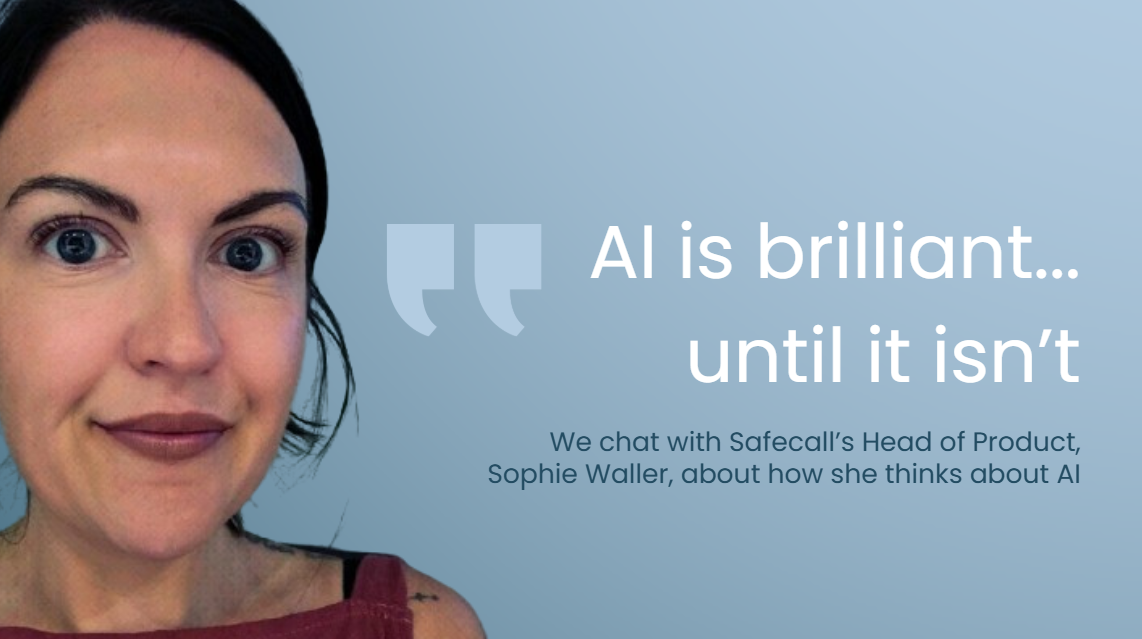
Most of us are using AI tools every day now, at work and at home. But when it comes to sensitive workplace matters – like whistleblowing reports – the risks of reaching for the wrong tool can be significant. We sat down with Sophie Waller, Safecall’s Product Manager, to talk about how she thinks about AI, what organisations should be aware of, and why we made AI Translation a native part of the Safecall platform.
Sophie, let’s start with you. How do you use AI in your day-to-day life?
Honestly, like most people, probably more than I realise! At work it helps me with drafting, summarising, thinking through problems. At home I use it for everything from recipe ideas to trip planning. The productivity gains are real, and I don’t think that’s going away.
But I’ve also learned – sometimes the hard way – that you have to use it properly. A colleague told me a great story recently. He was watching the World Cup and asked an AI tool how many players from his Premier League club had scored World Cup goals. The answer came back immediately, confidently, and completely wrong. He said it reminded him of having a chat with someone who’d had a few too many drinks at the match – full of conviction, not entirely reliable. It did make me laugh, but it’s a genuinely important point.
So what’s the lesson there for organisations thinking about AI?
That AI can never fully replicate human logic, emotion, and critical thinking. It’s a tool, and like any tool, understanding its limitations is just as important as understanding what it’s good at. I think back to when these tools first started to filter into working life, and I use them very differently now than I did then. There’s a real learning curve, and organisations that invest in helping people navigate that will be much better placed.
Let’s talk about the specific context of whistleblowing. Where does AI create risk there?
It’s a really important question, and one we’ve been thinking about a lot – both because of what we’re seeing in our own data, and because of what our clients are telling us.
Our 2026 Benchmark Report shows that 71% of reports are now submitted via web portal, up from 30% in 2019. That’s a significant shift. And we’re seeing a growing pattern of reports that appear to have been drafted with the help of external AI tools. That creates two real problems. The first is privacy – an employee raising a concern might put sensitive information about their organisation, their colleagues, or themselves into a consumer AI platform that offers no meaningful data protection. That information could be used to train AI models. It could end up somewhere it was never meant to go. The second issue is report quality. AI-generated content can be polished and confident in tone, but it may not accurately reflect what the reporter actually intended to say, which makes investigation harder.
And this isn’t just about reporters – the same risk applies to the teams receiving those reports?
Exactly, and I think this is the part that often gets overlooked. Imagine a report arrives in French, but your case handler speaks English. What do they do? They might paste it into an AI tool they already have access to, or run it through Google Translate. The intention is good – they want to do their job – but the result is the same: sensitive case content has now left your secure platform and entered a third-party system. Some organisations bring in external translators for complex reports, which is costly and introduces the same problem.
It’s one of those situations where the risk isn’t coming from bad decisions. It’s coming from people trying to do the right thing with the tools they have available.
Which is why you built AI Translation into the Safecall platform itself.
Yes. We wanted to close that gap entirely. AI Translation is built directly into the portal, so reporters, case handlers, and investigators can translate messages and full reports with a single click – without ever leaving the platform. No external tools, no third-party translators, no risk to confidentiality or the audit trail.
Every translation is cached, audited, and geo-restricted to enterprise-grade standards. The original is always preserved. And crucially, the content is never used to train AI models. We’ve thought carefully about the privacy architecture because we know how sensitive this information is.
Any broader advice for organisations thinking about AI policy and speak-up programmes?
Keep reviewing what you have in place, because the landscape is moving fast. The EU AI Act is now in force and organisations operating across Europe – or whose AI outputs reach EU users – need to be paying attention. But beyond compliance, it’s about culture. Help your people understand how to use AI well: what it’s good for, where it falls short, and when the stakes are too high to take shortcuts.
Whistleblowing is one of those areas where shortcuts carry real consequences – for the reporter, for the organisation, and for the integrity of the process. Getting this right matters.
Find out more about Safecall’s AI Translation
Safecall’s AI Translation is available to all clients, regardless of subscription level, from £500 per year. To find out more, contact your account manager or email [email protected].